HISTORY OF BALINTAWAK ESKRIMA
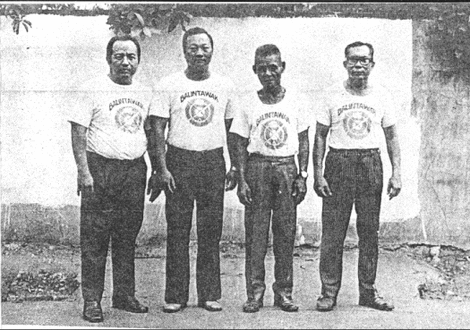
THE ORIGINAL BALINTAWAK from left to right
Atty. Jose Villasin, Johnny Chiuten, Anciong Bacon & Teofelo Velez
BALINTAWAK, also known as Balintawak Eskrima or Balintawak Arnis, is a style of Filippino Martial Art developed by Venancio "Anciong" Bacon in the 1950s from earlier tutelage of Lorenzo Saavedra. It is named after Cebu City's Balintawak Self Defense Club, where it was originally taught. In turn, the club took its name from the street of its location, Balintawak Street, where the original Balintawak masters trained.
Early in the 20th century, the colonizing Spaniards left the Philippines, ending their 300-year rule. In their place, came the Americans. It was during this period of change that Venancio Bacon was born in 1912 in Carcar, Cebu.
He learned eskrima in the 1920s as a teenager. His formation as an eskrimador began in San Nicolas. This would later lead him to death matches, attacks, and eventually jail.
Bacon's only teacher was Lorenzo Saavedra, of San Nicolas, who during this time had established the Labangon Fencing Club. At a time when many different styles of eskrima abounded, Saavedra’s was called the Corto Linear, although he was known to have mastered other styles. His best students were Teodoro Saavedra, his nephew, and Venancio Bacon. The Labangon Fencing Club, however, eventually dissipated into oblivion.
In 1932, the Doce Pares Club was formed and was headed by Lorenzo Saavedra.
Venancio Bacon was among the first members in the club and a few months later left the club due to arguments that the Doce Pares system was not an effective escrima.
World War II broke out in the Philippines in the early 1940s. With the onset of Japanese occupation, many eskrimadors became guerilla fighters, employing their art for the defense of their nation.
After the war, in 1952, along with Vincente Atillo, Delfin Lopez, Jesus Cui, Timoteo Maranga, Lorenzo Gonzales, Isidro Bardilas, Andres Olaibar, and a few others, Bacon established a new club, calling it the Balintawak Street Self-Defense Club.
THE ORIGINAL LOGO OF BALINTAWAK ESKRIMA
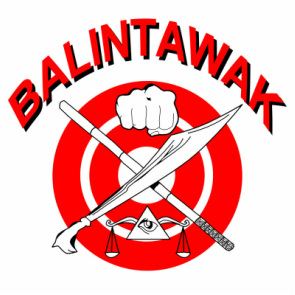
The Four Circles in the Bull’s Eye stand for the four levels of learning in Balintawak, namely Basic, Intermediate, Advance, and Mastery.
The stick is a mere extension of the arm and the primary weapon of Balintawak Eskrima.
The left fist represents the bare hand combat techniques of Balintawak. The art is just as effective with or without the cane.
The Bolo is the bladed weapon of choice for the Balintawak Eskrimadors.
The All Seen Eye in the triangle is a representation of the All Seen God
The Scales represent Justice.
The stick is a mere extension of the arm and the primary weapon of Balintawak Eskrima.
The left fist represents the bare hand combat techniques of Balintawak. The art is just as effective with or without the cane.
The Bolo is the bladed weapon of choice for the Balintawak Eskrimadors.
The All Seen Eye in the triangle is a representation of the All Seen God
The Scales represent Justice.
